Showing posts with label Kathmandu Nepal. Show all posts

Monday, March 7, 2011

Hotel at the End of the Universe


Maybe in reading the title of this blog post, you thought it was a pathetic attempt at a witty quip about our accommodations in the Himalayas…

Or maybe your mind immediately fastened onto Douglas Adams’ book Restaurant at the End of the Universe in which the main characters go to “meet the meat” before dining…

Or maybe (like me) you recalled the Family Guy episode when Peter tumbles into the great beyond…
Lois: …I just bought use some new sheets at Bed, Bath, and Beyond.
Peter: Oh boy, I hope you stayed away from that "beyond" section.
(Cuts to scene where Peter is pushing a shopping cart into a door labeled BEYOND.)
Peter: (Swirling through vortex) Ahhhhhhhhhhhhh-- Oh, here are the coffee mugs... 

But I request that you stop those thoughts before they continue much further, for Steve and I did in fact spend a night at the Hotel at the End of the Universe.  I kid you not.


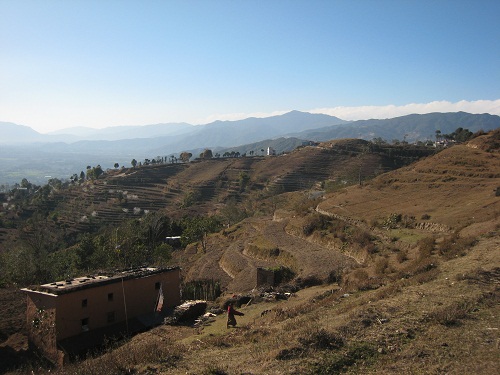
And, to boot, the view looked something like this…


What a magical place we stumbled upon, thanks to our trusty Lonely Planet guide’s recommendation.  For one evening we opted to leave the hustle and bustle of the lower Kathmandu valley to drive 2 hours up into the hills for the view and some relaxation.  The further we ascended, the more Steve gawked at the similarity between these hills and the Sierra Nevadas – an area of the world Steve is intimately familiar with having grown up hiking around the Lake Tahoe and Yosemite areas of California.  We trekked 3 hours up a paved road, past large weekend gatherings (which we later found out are a regular thing on government holidays), to a look-out tower that provided us with a 360° view of the valley and the Himalayas in the distance. The photos below detail parts of our hike and token tourist shots atop the tower.  


Back at our celestial hotel (who can resist such descriptions?  Apparently the locals can’t, as en route to our hotel we passed “Galaxy Hotel” and “Hotel Space Mountain” – too much of a good thing is….oh, never mind), we removed our tourist caps and recouped after days in the fast pace of Kathmandu and its surrounding towns.  The lack of ongoing electricity encouraged us to read and play cards by candlelight, enjoy some Nepalese beer and veggie pakoras, and eavesdrop on the young 20-something crowd that had gathered at the hotel for a reunion.  For hours, we just rested – recalling the many activities and sights we’d seen over the past week – but even moreso, reflecting on our experiences of the past 2 months. 


For 1.5 months now, we’ve been traveling around developing counties (Australia excluded of course, hence it only being 1.5 months despite our 2+ months on the road).  It has been wonderful to have the time to reflect at the “end of the universe” and now, at the Buddhist monastery in the town of Boudha, Nepal, where we’re living for 4 nights before departing this amazing country.  Supplementing our ongoing dialogues about what we’ve seen, experienced, will leave with, and are still amazed by, having 5 days before the big switch back into the western world has proven quite interesting.  In Thailand, we struggled with the idea of pushing ourselves out the door into the unknown,  encountering the intricacies of a southeast Asian country for the first time, and were amazed by our ability to adjust to the pace of life; in Bali, we addressed the idea of being tourists, consumers, and brief members of a society in which we found no amount of time on a “world trip” could suffice getting to know the place unless we moved there permanently for a tme (we have kicked ourselves a few times for not taking advantage of being freelancers for years and moving to a place like Ubud for a year+ while working from home….don’t worry, AU folks – we’re coming home); in India, the most challenging country of all, we struggled with and ultimately came to terms with being constantly observed by others, and as our friend Gloria put it so eloquently, “you can’t get away from the fact that you are Westerners,” not to mention being intimately involved with the “slum” life of India at Vidyanikethan, by far, one of the highlights of our entire trip; now, here, in Nepal, we’ve encountered some of that same “otherness” we found in other places, but we’ve approached it with a different set of eyes, and, in a way, an acceptance that we didn’t have prior to our trip.  


We’ve had the time to reflect on how we’ve grown accustomed to seeing impoverished children in dirty street clothes ask any passer-by for a rupee, and how, each time feels like a kick to the stomach – yet, still, we’ve gotten used to seeing that scene play out before us quite often.  We’re unphased by the number of animals (cows, goats, chickens, monkeys, dogs, hogs, etc.) that block the crazy city traffic of each country we’ve visited (and have often joked about how boring driving in Vancouver will be compared to, say, Mumbai).  We’re quite used to the lack of sanitation in developing countries that results in rivers filled with garbage, lack of public toilets, and thus, the use of sidewalks for bathroom purposes, and constant need to purchase clean water for 1.5 months for fear of contamination.  We’ve even, strangely, reaped the benefits of losing some added pounds while traveling due to non-Western food that doesn’t settle well with our uber-Western stomachs (don’t worry, we’re healthy and take all the necessary precautions to remain so, but why not look on the positive side and enjoy looking so shvelt?).

All of the above realities of travel in the developing world are important to acknowledge and to give oneself permission to learn from.  And I can’t stress enough how much we’ve enjoyed these exposures to life on the other side and how much we’ll take away from them.  Steve and I are both fortunate to be in fields that (big quote unquote) “help others.”  In fact, we couldn’t imagine being anywhere else, since we feel it is our duty as members of a healthy and safe society to do as much as one can, in whatever way you can, to contribute to that society.  When we return to Vancouver, I’m happily diving back into my job at an arts education non-profit that not only provides after-school and weekend programs in the arts, but works extensively in outreach programs to bring arts education to children who would otherwise not receive it.  Steve, I am so proud to say (and will take this moment to gush about), will be starting law school in the fall, with the hopes of focusing on systemic and policy changes within BC and, perhaps, Canada.  All of this, I must stress, is not to toot our horns, but to share with our readers how traveling of this kind can open your eyes, and reinforce everything you believe in – if not change your views for the better.  But, one doesn’t have to travel to the other side of the world to be challenged to make change, it can happen locally…


Okay…
 
Enough soliloquizing for now.  Funny how a night at the end of the universe and then a stay within the grounds of a monastery can make you break out the soap box.  I can conclude by saying, we’ve had an inspiring couple of months, and like every step of this trip, we’re so excited about the next one (that will be all the more enriched because we’ll be bringing every previous experience with us along the way).

This afternoon, Steve and I plan to visit the local Buddhist stupa to do laps for an hour under the prayer flags, while reflecting even more about our trip and anticipating the next move.  We’ve been doing a lot of walking these days – around cities, around stupas, and up in the clouds with a little guide (see photo below) – walking provides a great chance to see lots of things, but also to embark on a moving meditation perfect for reflection (or for planning where you’re going to have your next Nepalese meal).  I think walking to the end of the universe proved to be a great activity for us, even if it does warrant a few eye rolls at the mention of it.


 Next stop, the land of milk and hummus – Israel (unless you hear from Steve first)!

Wednesday, March 2, 2011

Can You Take Me to Crayola Town

We've spent nearly a week exploring Kathmandu and the surrounding vicinity, enough time for me to know this is a place I'd love to come back to and spend a lot more time. The preservation of architecture and history, the gentle nature of the people we've been lucky to meet, and the ancient, on-going cultural traditions are just a few of the aspects that make exploration here so fascinating. As we've said we're going to make this blog about specific things though, I'm going to pick the color of Kathmandu. Nepali society is bursting with color wherever you look - the clothes, the prayer flags, the temples, etc - so allow me to wax poetic about this piece of Nepali culture.


The streets of Kathmandu are packed with people, partially because as in Bangkok, so much of life occurs on the street level. As you walk along, it's impossible not to get drawn into the shops, each of which has arraigned their colorful wares to catch the eye. "Shops" is a relative term in Kathmandu, sometimes they are physical shops, sometimes just a stretch of wall to hang your massive copper pots on, or sometimes just a tarp on the ground with fabrics of every color available. As Sarah mentioned, the sales approach is pretty laid back, so we spent quite a while in some of the shops, rummaging through dust covered treasures (and worthless tchotchkes, of course).


The chowks (or squares) in town take what is happening on the streets and amplify it. On a busy day (like yesterday, during the Shivarati festival - more on this later) there is hardly space for motorcycles to wedge through. The rest is a kaleidoscope of the greens of fresh produce, the yellow, red, and black of lentils and beans in baskets, and the rainbow of saris. In some major squares, religious ceremonies are taking place as well. The above two pictures are of a ceremony called the ihi marriage ceremony, where young girls are married to a divine husband. This is done so that they can never experience the stigma of widowhood in orthodox Hindu tradition. The girls are dressed in brilliant red - the color of married women - with gold necklaces, bracelets, and earrings. Their foreheads are painted and some wear a white card as well with symbols on it.


Interspersed within the markets and streets are remarkably brightly colored stupas (Buddhist temples), which are both a part of the ancient history of Nepal, a living center of religion, and large tourist attractions. A typical stupa has a brilliant white dome, which is topped with a golden structure at the top, heavily engraved with symbols and figures from the Buddhist pantheon. Most are also adorned with the multi-colored prayer flags that flap in the typically strong wind off of the Himalayas. The stupa in the bottom shot is Swayambhunath, which is on a towering ridge over Kathmandu. We hiked up the steep staircase to the temple, watched a Nepali film crew taping a dance movie, and took in the sunset over the valley below.

(A little side note - on the way back we walked by one of the countless cattle in the road, and a big bull, in this case, got a little perturbed that Sarah was so close. He grunted, swung his head around and gave her a pretty good headbutt to the hip. It happened so fast that there was almost no time to be scared, and immediately afterwards Sarah had a huge surprised (and thankfully) unhurt grin on her face, as did the crowd of Nepali villagers who were around. They had a look that said, "Welcome to Nepal.")


The colors of Nepali society are by no means confined to markets, the stores, and the temples. The buildings themselves are a riot of color. The sky blue color in the top picture is quite popular (even in buildings so old they have begun to sag like knock-kneed drunks), and you can see it used again in for some detail work in the bottom shot. Some buildings, though, have gone all out and are mustard yellow, brick red, or adorned with intricate black woodwork.

The bright colors of Nepali life certainly work well with Sarah's color scheme. She's found herself a crimson red yak's wool sweater, a cerulean blue blanket, and an pumpkin orange pashmina. She looks just like a local...except for the bright red hair.


A post about the colors of Nepal would be sadly lacking without a few pictures of the people. From the Buddhists monks in their traditional robes on an alms round, to a woman going about her daily business in a typical Nepali outfit, to a young boy in a bright red robe playing amongst the stupas, to finally a very old women, supported by her family, who looked to have come to Kathmandu on a pilgrimage from a mountain town, dressed in what is likely her best apron of pink, purple, and blue.

The Shivaratri Festival that I mentioned earlier was another opportunity for us to see a traditional celebration for Nepalis that has been going on for generations but has incorporated modern bits and pieces (much like Halloween or Easter in the States or Canada). According to one local custom, kids can run around the back alleys with ropes stretched across the road

And finally, what do the Westerners wear amidst this brightly colored background? Black and grey... (this shot is pre-sweater of course).

Saturday, February 26, 2011

Valley of the Dolls


You all remember this image from the movie E.T., right? E.T. is hiding amongst Drew Barrymore’s dolls, trying to blend in. Steve and I have been experiencing many moments on this trip that we’ve named “E.T. moments.” The kind of moments that remind us of “Home….home….” with outstretched glowing fingers, dusty voices, and feelings of familiarity that surprise us when we’re 13h45m from our home time zone.

The city of Kathmandu, in the stunning Kathmandu valley (hence the blog title), has been a remarkable change from the feelings, smells, colours, and pace we found during our three weeks in India. It’s a welcome change – even the temp difference which forces us to exchange the thin layers of shorts and tees in exchange for long johns, gloves, and space heaters – that has struck me as being more familiar than other places we’ve been. The world is huge, we’ve proven that over the last 2 months, but there are similarities that stretch from one side of it to the other. Especially, I’ve found, in the bustling city of Kathmandu…


For starters, the colour of the sky as a result of the weather. At first, I couldn’t quite place the feeling of leave-less trees and murky sky that we flew into two days ago. The brown and brick-coloured buildings with their intricate wood carvings took on a more solid and frosty appearance than anything we’d experienced. The weather was on the verge of allowing one to see her breath as we walked through the Garden of Dreams, a mid-city garden mecca located amidst the narrow alleyways and temples. The neo-classical architecture dates back to the 1920s, commissioned by a Nepalese field marshal partial to the Edwardian style and in need of a respite in the city. Now visitors can fork up 130 rupees (slightly less than US$2.00) to stroll through the private garden or have high tea on the veranda. As a first stop in Kathmandu, this was a puzzling one – but not because of the European-influenced garden (which is kinda familiar), but because of the manner in which the dormant flora reflected the sky. I finally pinpointed the feeling: it was the silent moment in New England right before the first big snow, after the leaves have fallen off the trees. We’ve been told there are 6 seasons in Nepal, I have yet to identify the unfamiliar outstanding two (does anyone know?), but having reached the end of their wintertime, I feel at home in a way that I can only recall while strolling in winter coats along Massachusetts Avenue in Boston, or crunching over recently-frosted undergrowth in the east coast woods (much like our time at Shana and Bryan’s wedding in Poughkeepsie).

In addition to the weather, which has followed us around the city, just before leaving the Garden of Dreams, we also stumbled upon a plaque with a quotation from one of my Zaydie’s favourite books of poetry by Edward Fitzgerald, the Rubaiyat of Omar Khayyam. So nice to have a little reminder of him, while at the same time a reminder of home and sitting across many-a-tables hearing him recite poetry.
Another familiar aspect of this city is the people. Unlike our experience of being both the observer and the observed in India, which lasted the entire 3 weeks, the Nepalese folk we’ve found in Kathmandu have had more of a tendency to continue doing their thing with only quick glances in our direction. Perhaps I’m feeling the sense of familiarity because our experience in India was like no other and but moreso because there is an obvious efficiency in their work ethic that just continue despite the pale people wandering by that is reminiscent of some of my Western experiences. From the vendors who approach us with mandala necklaces and mini chess boards to the receptionist at our hotel, there is an outward gentility toward others that gives me a real feeling of respect and willingness to help, but also leaving me with no doubt that they’ll get it done. A salesman saw us looking at his yak wool blankets and asked if we would like to have a closer look inside his store – Steve and I, ever-prepped for a bargaining game and not in the market to make a purchase at that point, quickly shouted, “No thanks!” The man sensed our apprehension and said, “Not to worry, looking is free, take your time” and backed away. This could have been his sales pitch (that certainly worked), but we later experienced a similar “okay, not to worry” attitude coming from the vendors. This feeling of being allowed the time and space to look at something is certainly more familiar than some of the expert salespeople we’ve encountered in Thailand, Bali, and India. And we’ve many tchotchkes to prove it.


The receptionist at our hotel, who I mentioned earlier, is a no-nonsense gal. She’s sweet and respectful when we asked to stay a few more days, inquired about laundry services, etc., and then when we turned away, her voice rang out above the sound of the guitar being strummed by a fellow foreigner staying at the hotel as she instructed the doorman, server, and travel agent all at the same time about various jobs they should be getting on! You might be thinking, “Sarah, how is that an E.T. moment if the woman was just doing her job?” I can honestly attribute that feeling to my tickled egalitarian heartstrings which get plucked when a woman exerts herself in a culture where women’s rights are not equal to men’s (interesting blog post about that HERE.)
 
Aside from those obvious similarities that have made Kathmandu an instantly-comfortable home for 12 days, there are smaller ones as well: the smell of the fire pit at the cafĂ© we visited last night bringing out memories of numerous Westfalia-based camping trips with our Vancouver peeps; hearing the attempt of an American accent when the musician sings at the bar; the almond shape of my cousin Sophie’s beautiful eyes reflected on some of the locals’; the feeling of a thick duvet on a cold winter night in Massachusetts; the taste of the local Nepalese dumpling dish (momo) that Steve has cooked as a late night stack in many of our kitchens; etc. We’ve been collecting these moments ever since we embarked on our journey 2 months ago, but for some reason, in Kathmandu Valley (of all places), I’m sensing home even more than usual. 

Have you had any “E.T. moments” while abroad that you can remember?