We now interrupt your regularly scheduled blog post to give you a blog in two parts – the first announcing the winner(s) of our “Guess how much we paid for Valentine’s Day Dinner” contest and the second is related, but a slight detour from our usual travel posts.
Part One: And the winners are…
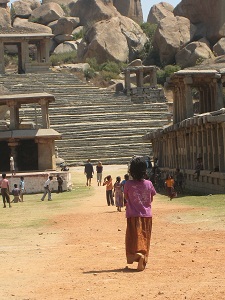
India is a remarkable place to travel not only because the culture is like none other we’ve ever experienced, but for two frugal travellers, it’s extremely easy to stay within, if not well under your budget! So, many of you were close…the ballpark 200-250 rupee guesses (thanks, Joel and Noah) were a bit low (that’s about US$ 5.00), but indeed a good guess as we’ve had many meals that were close and/or under that. The free guess (thanks, Paul) would have been nice, alas, ain’tnothing free in India. Taking photos (such as the one below) can cost you up to US$2.00. But the TWO ladies, very near and dear to our hearts, who guessed the same price at $9.00 are:
TIANNA HUSTON and KELLY MCCARTHY! Indian goodies will be in the mail soon…
We, in fact, paid $9.50 for our splurge of a V-Day dinner. We shared a delicious Special Veggie Thali (a platter of squash and veggie korma, rice, chapatti, and some other delicious mouth-burning side dishes – US$2.50), a PalakPaneir dish (spinach and potato) + chapatti (US$2.50), one mango and one papaya lassi (US$2.00), and a yummy dessert of nutella, banana, and coconut crepe (US$1.50), plus tax and tip, bringing us up to $9.50. We probably won’t ever have a V-Day meal that cheap again.
Congrats, ladies. We think you two and your respective hubs and fams (yay, Kent, Jake, and Jimmy Mac!) should visit India sometime to try out your price-guessing skills first hand.

Part Two: A Day in the Life…
Whether it is through the occasional query on family Skype calls or in the emails from friends that read “I know you’re busy…,” I’ve been sensing a curiosity as to how we spend our days on the road. I would like to take a short break from our usual site-specific post to give you a glimpse into a day in the life of Steve and Sarah. Of course, every day is new and different with each passing country, city, and cuisine, but there are several daily occurrences that have become as familiar and predictable as…say...a hot shower used to be.
If you’re curious – read on, if not – Steve will be telling you all about our travels in the Indian state of Goa shortly.
(Please note: Times are relative depending on jet lag, bleating goat noise outside our bedroom, or the frequent need to just go with the flow.)
6:30-7:30ish Wake up: Sarah is usually cradling her Mona Lisa pillow and Steve is cocooned inside his sleep sack (photos below). Mona has come in handy, acting as a.) a stuffed animal-surrogate, b.) apillow for airport sleeps, or c.) a meditation pillow for the brief attempts at the end of our yoga sessions. The sleeps sacks have also come in handy when we’re a.) too cheap/frugal to rent a room with sheets or b.) tooweirded out by the sheets provided.


7:30-7:45ish Yoga (yes, Geraldine, yoga). Happily, yoga has started most of our days. Our sessions usually last about 30-45 minutes and hardly have us doing no-hand headstands in Hampi, but making (and having) the time for a little stretching in the morning has made our long-walking days and sore backs from harder-than-we’re-used-to mattresses all the more bearable.That, and our arms are looking buff. :)


8:30ish Post- (and sometimes during) yoga music. Out trusty iTunes has come in handy by reminding us of home with some familiar tunes. Paul Simon, Gillian Welch, Ray LaMontagne, and The Great Lake Swimmers have set some nice, homey tones for the days.
During this time, we also embark on some shower and washing up journeys – most of which have consisted of conserving water via Navy showers (turning off the water when soaping up) or bathing in buckets left in the bathrooms. About 30% of our showers have been sans hot water, but then again, over 80% of our weather has been tee-shirt weather. It’s an easy trade off. We’ve both gotten quite good at the bucket baths and brushing our teeth with bottled water. And, it’s also worth mentioning, I have a new and immense appreciation the western toilet. I’ll leave it at that.
9:00ish Breakfast – sometimes included in our accommodations, sometimes not. We tend to cling to western favourites (eggs, fruit salad, muesli, yogurt) and also, we’ve tended to stick to one place once we find a place we like. The servers are often sad to see us go when we (mainly Sarah) share that “it’s our last morning here!”It’s nice to feel like regulars on the other side of the world.
9:45ish Packing the bag for the day – Sunscreen, check! Camera, check! Bug spray, check! Kleenex, check! Digestion-aiding enzymes, check! Books, check! Water, check! Money, check! “Okay, come on, Sarah….let’s go….” (Yeah, I tend to take a little while to pack up where as Steve could fall out of bed and go.) Sometimes the bag-packing feels a bit like Mom sending me off to the first day of school with all new my pencils, erasers, folders, lunch boxes, gym clothes, locker combinations, etc., but on the rare occasion that Steve’s gotten a sunburned neck or Sarah’s had the sniffles, it’s nice to have all the supplies readily available.

10:00-1:00ish A fun local activity! This can be anything from visiting Buddhas in Bangkok, to touring ruins in Hampi, to roaming through neighbourhoods in Ubud, to browsing for pieces of local art in Sydney. We find we’re usually good for a solid 3+ hours before the hottest part of the day sets in.

1:00ish Lunch – this can be anything from a local cheap eat to a picnic on the grass with the Tupperware we bought in Melbourne (one of our best purchases by far). Our picnics tend to consist of hard-boiled eggs, fresh veggies, cheese, and (in India) some “just open and serve” lentil dishes.

2:00-4:00ish Another fun local activity! If we were hard-core tourists in the morning, we’ll make our afternoons more low key, or vice versa. Of course, we always allow ourselves the downtime needed to not run ourselves into the ground during these five months.


4:00ish Cold or hot drink and a read – we’ve naturally fallen into the habit of having an afternoon drink (iced tea, lassi, chai, etc.) coupled with either reading, writing, journaling, knitting, catching up on emails, or just people-watching for a few hours before evening time. Steve’s been a superstar with his writing (book, blog, etc), meanwhile, Sarah alternates between knitting a baby blanket for her childhood friend and hub’s (yay, Kelly and Jake!) baby due this summer, reading, or journaling. This downtime has been such a lovely part of the trip. The act of disappearing into a book and/or world-escaping activity has made the exploratory parts of the trip that much more doable.


6:30-7:00ish Dinner – like lunch, we’ll either sample the local cuisine or have a picnic at home. Often this is a great chance to reflect on the day, or to just enjoy each other’s company with a glass of wine and silence.
Evening time – During this time, we end up doing any number of activities: catch a local dance performance, slowly stroll home the long way, look through our photos, write on the blog, pop in for dessert somewhere, or, really, anything we’re up for.
So there you have it: a day in the life of Steve and Sarah. Our days have been so filled with many wonderful things that it’s important to be flexible at any given time during the day to allow for more wonderful things to happen. But as creatures of habit, the above-mentioned schedule tends to be a fairly regular one. That is, of course, unless we must take a 12-hour sleeper bus across Indian states, succumb to spending the day in bed due to an unhappy tummy, or are just feeling like lounging on the beach/in a park/at a café from 9:00am-4:00pm. Part of getting to know the places we’ve visited has been about just being ourselves in different locales. It’ll be fun to see how new places and additional people (yippee Mom and Pete!) throughout the rest of our trip will alter our daily goings-on.
In the meantime, the journey continues…